
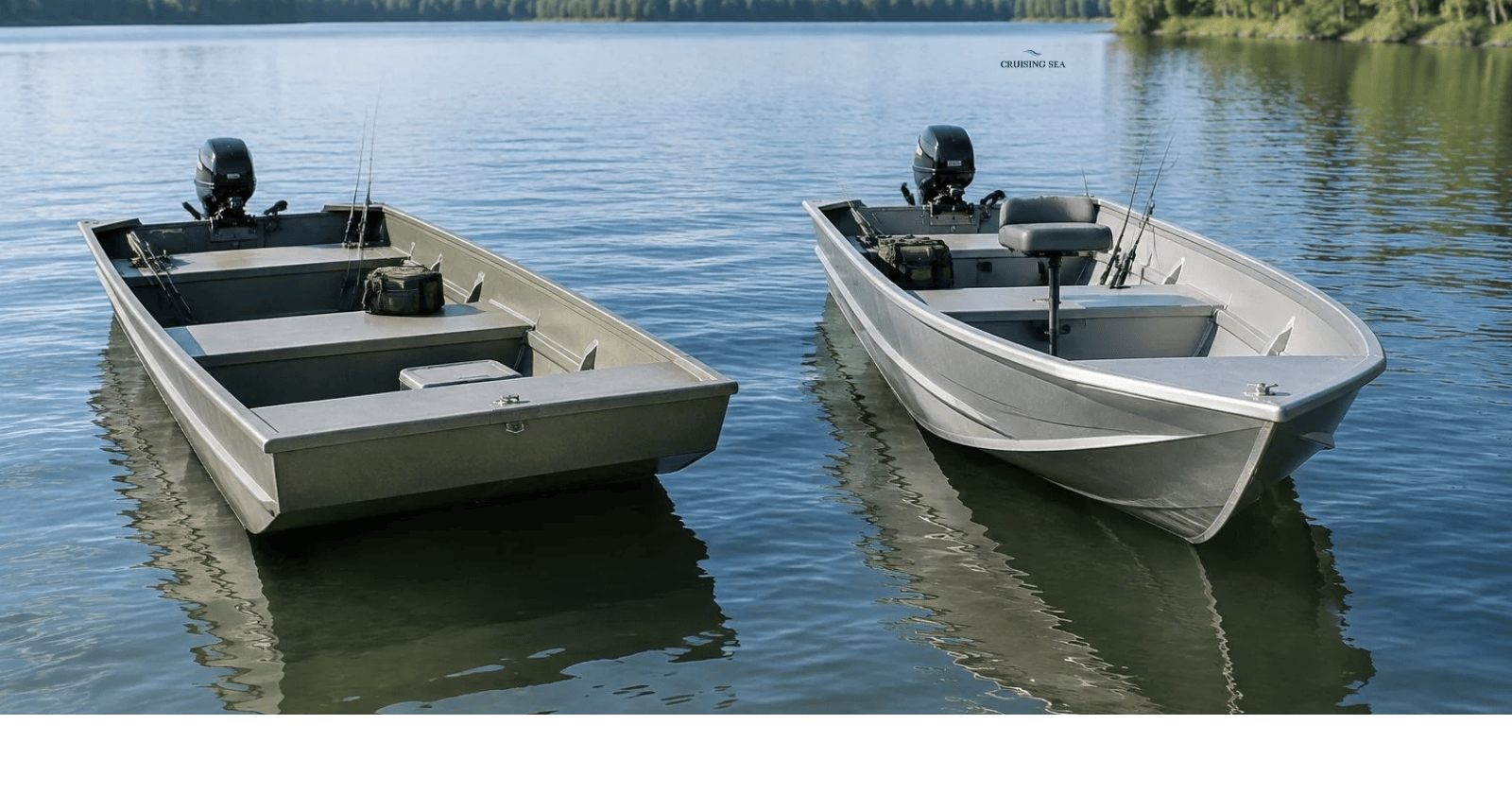
Not all aluminum boats handle the same way once they hit the water. When considering Jon Boat vs. V-Hull: The Real Differences, a flat bottom and a V-shaped hull behave very differently. They differ whether you’re standing still to cast or punching through chop on a windy afternoon.
Add ‘modified-V’ into the mix. The term covers a wide range of hull designs. Understanding these nuances helps you pick the right boat for your water. Each setup changes stability, handling, and ride quality in different ways. Consider the typical water, your load, and your preferred pace.
Here’s what actually separates these hulls. First, look at stability at rest and initial planing. Next, evaluate turning, tracking, and spray. Finally, assess comfort over chop and rough water. Also consider ease of loading and fuel efficiency in everyday use.
Which Hull Works Better in Calm and Choppy Water?
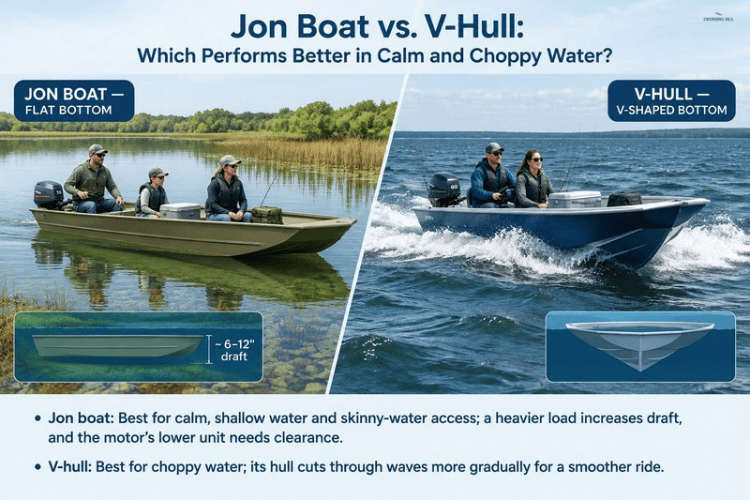
A flat-bottom jon boat gets you into skinnier water, while a comparable V-hull gives you a smoother ride once things get bumpy.
On quiet ponds and sheltered backwaters, that flat bottom’s broad footprint really pays off. Its shallow draft—basically how deep your hull sits below the surface—lets you sneak into skinny spots. Just know that passengers and gear push that draft deeper, and your outboard’s lower unit needs room to clear the bottom too.
Once you hit chop, though, that same flat bottom starts slapping against waves instead of cutting through them. A V-shaped bottom enters the water more gradually, so you feel less of that pounding.
Here’s how boats of similar length, width, and loaded weight tend to compare:
| Your consideration | Flat-bottom jon boat | V-hull boat |
|---|---|---|
| Calm-water feel at rest | Firmer | More rocking |
| Hull draft | Usually shallower | Usually deeper |
| Ride in chop | More pounding | Softer entry |
| Shallow-water fishing | Strong fit | More clearance needed |
| Power for similar speed | Often lower | Often higher |
Rough-water performance isn’t just about hull shape, either—length, freeboard, and where you put your load all matter. Freeboard, by the way, is just the distance between the waterline and the top edge of your hull.
When the water gets choppy, slow down before the impacts turn harsh, and keep a sheltered route back in your pocket. Even a small V-hull needs conservative weather limits.
How Do Deadrise and Modified V-Hulls Change the Ride?
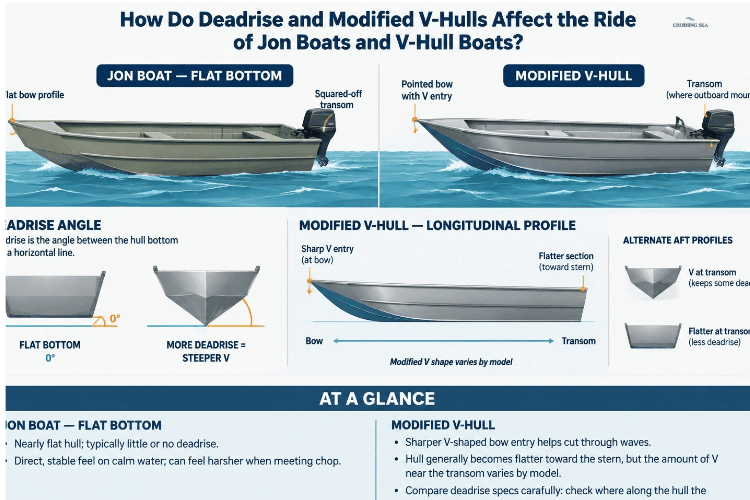
More deadrise means a sharper V-shaped bottom. A modified V-hull blends that sharper bow entry with a flatter stern.
Deadrise is simply the angle between the hull bottom and a flat horizontal line—a totally flat bottom sits at zero degrees, and the angle climbs as the V gets steeper.
When you’re comparing specs, check exactly where the manufacturer measured that deadrise. A sharp bow helps you cut through waves, but the bottom shape farther back toward the stern affects the ride too.
A modified V-hull (mod-V) changes shape as you move along the boat’s length. Some keep a noticeable V all the way to the transom (that’s the back wall where your outboard mounts). Others flatten out almost completely near the stern.
If you’re shopping for a “V-hull jon boat” or “modified V-hull jon boat,” ask the dealer for:
- Bow and transom photos showing the actual bottom shape
- The published transom deadrise, if they have it
- Loaded draft figures, and what load that number assumes
- A demo with weight close to what you’ll actually carry
Treat terms like “mod-V,” “semi-V,” and “deep-V” as rough starting points, not promises. Manufacturers use them loosely, so look at the real hull geometry before you judge how it’ll ride.
Which Hull Is More Stable for Fishing?
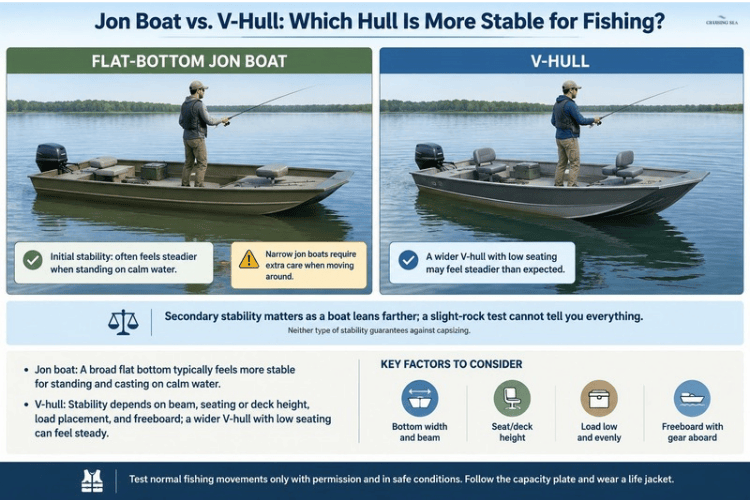
If you’re standing and casting on calm water, a broad flat-bottom boat will typically feel more stable than a similarly sized V-hull.
That’s called initial stability—how much a boat resists the first few degrees of lean when you shift your weight, grab tackle, or stand up.
Then there’s secondary stability, which kicks in as the boat leans further. You can’t tell much about secondary stability just from how a boat feels when it rocks a little, and neither type of stability is a guarantee against capsizing.
When comparing a flat-bottom jon boat to a V-hull, look past the bottom shape and check:
- Bottom width and beam – both floor-level width and the boat’s max width
- Seat or deck height – standing on a raised deck raises your center of gravity
- Load placement – keep heavy stuff low and spread evenly
- Freeboard – how much side height is left once your normal gear is loaded
A narrow jon boat demands extra caution when you’re moving around in it. On the flip side, a wider V-hull with low seating can feel steadier than you’d guess.
If you get a dealer demo, try your normal fishing movements (with permission, under safe conditions). Stay within the capacity plate limits and wear your life jacket.
How Do Size, Motor Choice, and Cost Affect Your Decision?
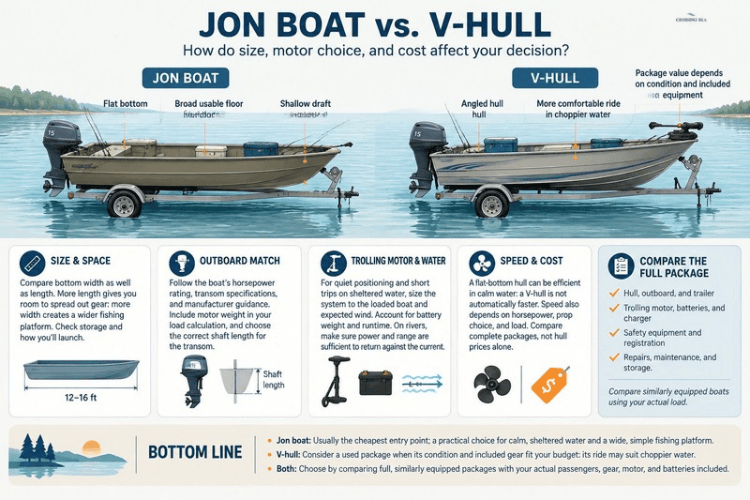
You’ll make a smarter purchase by comparing full, similarly equipped boat packages—with your actual load factored in.
For a 12–16 foot aluminum boat, look at bottom width alongside length. More length gives you room to spread out gear; more width gives you a wider fishing platform. Don’t forget storage and a practical launch setup, too.
Match your outboard to the boat’s horsepower rating, transom specs, and manufacturer guidance. Factor the motor’s weight into your load calculations, and make sure you get the right shaft length for your transom setup.
A trolling motor works well for quiet positioning and short trips on sheltered water. Size the system to your loaded boat weight and expected wind, and don’t forget battery weight and runtime. If you’re running rivers, make sure you have enough power and range to get back against the current.
Flat-bottom hulls are actually pretty efficient in calm water, so don’t assume a V-hull will automatically be faster. Speed comes down to horsepower, prop choice, and load just as much as hull shape.
When it comes to cost, make sure you’re comparing what’s actually included:
- Hull, outboard, and trailer
- Trolling motor, batteries, and charger
- Safety equipment and registration
- Repairs, maintenance, and storage
A basic jon boat will usually be your cheapest entry point. A used V-hull package can still be worth considering if the condition and included gear line up with your budget.
Choose the Hull That Fits Your Usual Waters
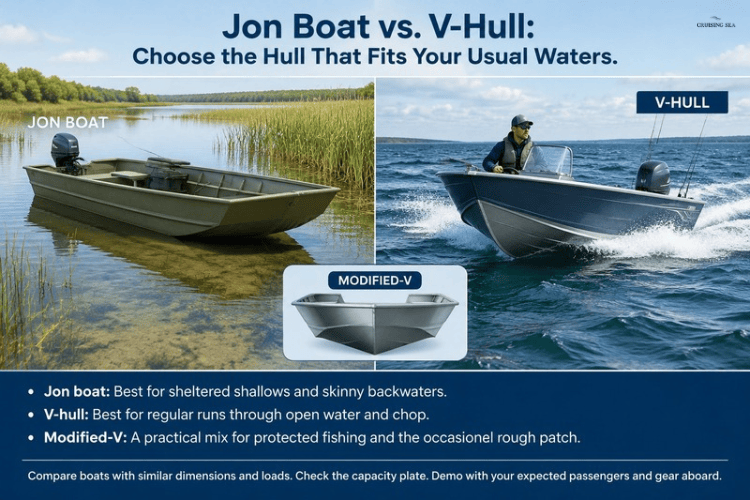
Pick a jon boat for sheltered shallows, a V-hull for regular runs through chop, or a modified-V if you want a mix of protected fishing and the occasional rough patch.
If your favorite spots are skinny backwaters, prioritize shallow draft. If you’re regularly crossing open water, weight ride comfort more heavily. Before you buy, compare boats with similar dimensions and loads, check the capacity plate, and get a demo with your expected passengers and gear aboard.
Frequently Asked Questions
Before committing to a small aluminum boat, check modifications, motor fit, and overall condition.
Can you add a raised casting deck to a flat-bottom jon boat? You’ll need to account for the added weight and higher center of gravity. Ask the manufacturer what modifications are safe, and include the deck’s weight in your total load calculation.
Can you transfer your outboard to a modified V-hull jon boat? Sure—as long as its horsepower, weight, shaft length, and mounting requirements match the new boat’s specs. Check the capacity plate and manufacturer guidance before counting on your current motor working.
What should you inspect on a used aluminum boat? Look for cracks, damaged seams, loose rivets, corrosion, and any transom movement. Ask for an on-water leak check, and inspect the trailer before you settle on a price.
Does a v-hull jon boat need a different trailer? Your trailer needs to match the hull shape and loaded towing weight. Check bunk placement, transom support, and capacity with the boat or trailer manufacturer before assuming your current trailer will work.
More reading:

Daniella has been passionate about travel, the sea, and nature for many years. As a child, she frequently traveled throughout the Mediterranean and continued with her journeys throughout her adult life.
Her experiences have created the desire within her to share her love for traveling with other passionate and adventurers who want to discover beautiful horizons and new cultures.